Market Update 29 June: Advanced in the Bear, Not Yet a Bottom
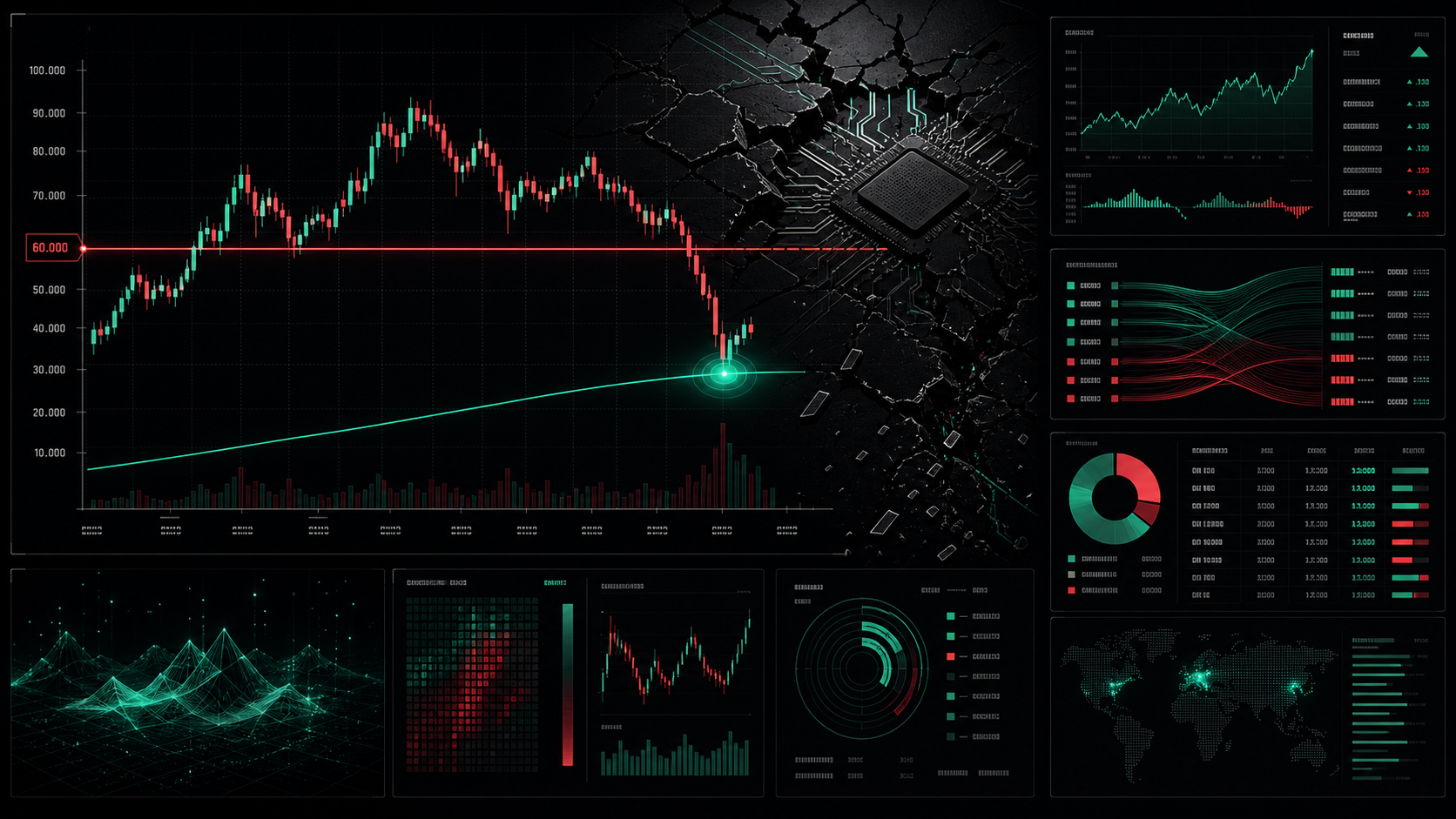
BTC broke the $60k level for the first time since late 2024, traded to roughly $58k-$59k, and then reclaimed the round number into month-end. Our base view: the market is advanced in the bear phase, but the bottom is not confirmed yet. Sentiment, on-chain loss metrics and long-term moving-average tests look like bottoming ingredients; ETF redemptions, shrinking stablecoin liquidity and a still-hawkish macro tape say the market has not rebuilt the bid.
The key change from prior cycles is that crypto is no longer the only high-beta liquidity expression. AI equities and semiconductor-linked risk now carry a larger volatility profile, and the late-June break in that trade matters for crypto because it controls where the next marginal risk dollar goes. If the AI trade cools without turning into a full risk-off event, crypto can stabilize. If AI deleveraging becomes the dominant portfolio problem, BTC probably remains a funding source rather than a destination.
At a glance
- BTC fell ~5.9% on the week and tagged the high-$50k area. The immediate fight is whether the market can turn $58k-$60k into a base or whether a close below that zone opens the realized-price pocket closer to the mid-$50k area.
- ETH underperformed again, down ~7.9% and trading near $1,550-$1,600. This is still a BTC-led defensive market, not a broad crypto risk-on tape.
- U.S. spot BTC ETFs remain the main pressure valve. SoSoValue data cited by Cointelegraph showed $696.3M of outflows in one session and $3.61B of June outflows by June 26; Bitbo's flow table showed -$1.48B over the latest 10-session window.
- Stablecoin dry powder is contracting. The stablecoin market reportedly shed $9.45B since May 8 and $2.12B in the latest week, according to The Currency Analytics. That is not the liquidity backdrop of a confirmed accumulation phase.
- Macro is still restrictive. May PCE was reported at 4.1% YoY, the highest since 2023, while the dollar pushed near a one-year high and the 10Y Treasury traded around 4.38% on flight-to-quality demand.
- Strategy reduced tail risk but changed the signal. The company announced a 12% STRC dividend, $2B of buyback authorizations, a $2.55B USD reserve and a BTC monetization program of up to $1.25B, according to its June 29 press release. This helps the capital stack, but it also makes the treasury bid conditional.
The AI trade finally cracked
The macro story this week was not a generic equity crash. It was a rotation out of the AI complex.
The Nasdaq Composite fell roughly 4.6% for the week and closed Friday with a fifth consecutive down session, while the Russell 2000 held up better and defensive sectors caught bids. CNBC's market coverage noted that the VanEck Semiconductor ETF was down about 7% on Tuesday, and later reporting from Oninvest put semiconductor stocks down more than 7% for the week, their worst stretch of 2026. The read-through is simple: investors did not dump all risk at once; they sold the crowded winner.
Micron was the tell. The company delivered a strong earnings setup, but the stock still became a pressure point because expectations had moved too far. When a stock can beat and still sell off, the market is no longer paying for results; it is repricing positioning, capex durability and valuation. That matters for crypto because the same liquidity pool funds both trades. In 2024-2025, BTC was often the cleanest high-beta expression of easier policy and institutional adoption. In 2026, AI equities have absorbed that role.
This creates a different playbook. A mild AI cooldown is constructive because it reduces the competition for speculative capital. A disorderly AI unwind is bearish because portfolio managers sell liquid winners and high-vol assets to protect books. Late June looked like the first stage: rotation, not panic. But crypto will not get a durable bid until the market believes the AI reset is contained.
Macro: oil helps, PCE hurts
The macro tape is mixed but still restrictive for crypto.
The bearish side is inflation. May PCE was reported at 4.1% YoY, with core PCE around 3.4% in multiple market summaries, leaving inflation materially above the Fed's 2% target. That keeps the market focused on higher-for-longer policy and even leaves room for hike risk if the data fails to soften. Coindesk's June 22 daybook had already warned that ETF bleeding plus a stronger two-year yield pointed to lower odds of a convincing BTC recovery, even as oil cooled.
The constructive side is energy. Brent fell sharply toward pre-war levels, easing one of the worst inflation inputs from March through May. If lower oil feeds into June and July inflation prints, the Fed gets more room to hold rather than tighten. That is the path for a BTC relief rally: softer energy, softer dollar, ETF redemptions slowing, and a reclaim of the $66k-$67k area.
But relief is not regime change. The dollar near a one-year high is a headwind for global liquidity. The 10Y near 4.38% shows the market still wants duration during stress, not crypto beta. Our read: macro can stop pushing BTC lower, but it is not yet pulling BTC higher.
The liquidity funnels are not turning
Crypto bottoms need a change in flow direction. We do not have it yet.
ETF flows are the cleanest institutional signal. Cointelegraph reported $696.3M of U.S. spot BTC ETF outflows on June 26 as BTC slipped below $60k, pushing June outflows to $3.61B and year-to-date net outflows to $4.6B. Bitbo's ETF table showed -$666.3M on June 25, -$438.0M on June 24 and -$152.1M on June 23, with -$1.48B over the displayed 10-session period. The exact source varies by timestamp, but the direction is not ambiguous: the ETF wrapper has flipped from structural buyer to marginal seller.
Stablecoins are not replacing that bid. A shrinking stablecoin base means less deployable collateral on exchanges, weaker dip-buying capacity and less confidence that capital is waiting to rotate back on-chain. The reported $9.45B supply contraction since May 8 is not catastrophic in isolation, but paired with ETF outflows and weak ETH demand, it becomes a liquidity warning.
Digital asset treasury demand is now conditional. Strategy's new framework improves solvency optics by creating a cash reserve, increasing STRC's dividend to 12%, and authorizing buybacks. The market was right to reward the reduction in disorderly-blowup risk. But the program also formalizes something important: a large Bitcoin treasury vehicle can now monetize BTC to fund obligations when that is more attractive than issuing equity. That does not mean forced selling is imminent. It does mean the permanent bid has become a managed capital-allocation tool.
On-chain says capitulation is real
The strongest bull argument is that on-chain stress has already reached bear-market levels.
Coindesk reported earlier in June that BTC supply in loss had exceeded supply in profit, with roughly 10.5M BTC underwater versus 9.8M BTC in profit, while price touched the 200-week moving average around $61.3k. Later reports put supply in loss as high as 10.83M BTC, or roughly 54% of circulating supply, after BTC slipped under $59.1k.
That is not a normal pullback. More than half the network underwater is a deep bear-market signal. Historically, this zone appears around major lows, not near cycle tops. Sentiment confirms the same pain: Fear & Greed readings between 12 and 18 over June 28-29 put the market in extreme fear, with some reports calling it the lowest reading of the 2026 correction cycle.
The nuance is timing. Bottoming conditions can appear months before a clean trend reversal. In prior cycles, supply-in-loss crossovers and 200-week tests often marked the area where long-term accumulation improved, but the market still needed time to absorb forced sellers and rebuild liquidity. We think this is the right framing now: BTC is in the value zone for multi-quarter allocators, but still dangerous for levered traders trying to pick the exact low.
BTC levels: $58k is the line, $67k is the proof
The chart has become cleaner after the washout.
- $58k-$60k: primary defense zone. BTC needs to hold this area on daily closes to turn the late-June break into a bear-market trap rather than a continuation.
- $61k-$62.5k: 200-week moving-average / repair zone. Reclaiming it would reduce technical stress, but it is not enough by itself.
- $66k-$67k: first real proof of demand. This is where a relief bounce becomes something more credible.
- $70k-$75k: supply zone. We would expect sellers to appear here unless ETF inflows return.
- $54k-$55k: downside support if $58k fails. This lines up with realized-price-style bear-market discussion and would likely trigger another sentiment flush.
Our tactical read is that BTC can bounce from the current zone because fear is extreme and the market has already liquidated a large amount of late-long exposure. But the medium-term read is less friendly. Summer liquidity is thin, ETF flows are negative, and macro catalysts remain data-dependent. A bounce is tradable; a bottom requires flow confirmation.
ETH and alts: no leadership signal
ETH remains the weak major.
The market does not need ETH to outperform every day, but a durable crypto recovery normally needs ETH/BTC stabilization, DeFi risk appetite and broad alt participation. We do not have that. ETH near $1,550-$1,600 while BTC defends the high-$50k area tells us allocators still prefer the cleanest institutional asset rather than beta.
Alt flows are even more selective. Some newer ETF-linked products and narrative assets can attract capital even while BTC and ETH products bleed, but that is rotation, not expansion. A real alt regime needs stablecoin growth, lower real-rate pressure and BTC holding support. Until then, we prefer BTC-first exposure and selective event-driven alt risk, not broad beta.
What changes the view
We would upgrade the market if three things happen together:
1. ETF outflows slow and then flip. One positive day is not enough. We want several sessions of net creations led by the largest low-fee BTC products, followed by ETH ETF stabilization.
2. Stablecoin supply stops shrinking. The market needs dry powder. A flat-to-rising stablecoin base would show that capital is returning to crypto rails rather than exiting to fiat or other assets.
3. BTC reclaims $66k-$67k while AI volatility cools. This would show that the high-beta rotation is no longer sucking oxygen away from crypto.
Near-term catalysts are payrolls brought forward by the July 4 holiday, the next ETF flow prints, the behavior of STRC under the new capital framework, and whether BTC can defend $58k-$60k into the monthly close.
Our view
We think the market is close enough to bear-market stress levels that long-term investors should pay attention, but not strong enough to declare a bottom. Capitulation is visible in sentiment and on-chain loss metrics. The 200-week moving average is in play. BTC has tested a zone that historically matters.
What is missing is the bid. ETFs are bleeding, stablecoin liquidity is contracting, ETH is not leading, and the biggest Bitcoin treasury story has shifted from pure accumulation to active capital management. That is not a disaster; it is exactly what late-bear repair looks like. But it argues for patience.
Our view: BTC is advanced in the bear, not confirmed at the bottom. We would buy panic selectively and avoid chasing relief until ETF flows, stablecoins and treasury demand turn together. The first real confirmation is not a headline; it is BTC reclaiming $66k-$67k with positive flows behind it.
[AI DISCLAIMER]
This report was automatically gathered, analyzed, and drafted by Lucci's specialized AI research system.
Although we continuously optimize the model for professional research workflows and objective data handling, the content may still contain errors or lag real market conditions. Please use it as reference material and take full responsibility for any investment decisions.